Live Tracker
Texas heat, compared with the protections already required for school practices.
An existing Texas benchmark
UIL’s school heat protocols became mandatory on August 1, 2026. We use their published WBGT bands to put a Texas workday in context. The comparison shows what schools must do at these conditions; worker protection also depends on the job and the worker.
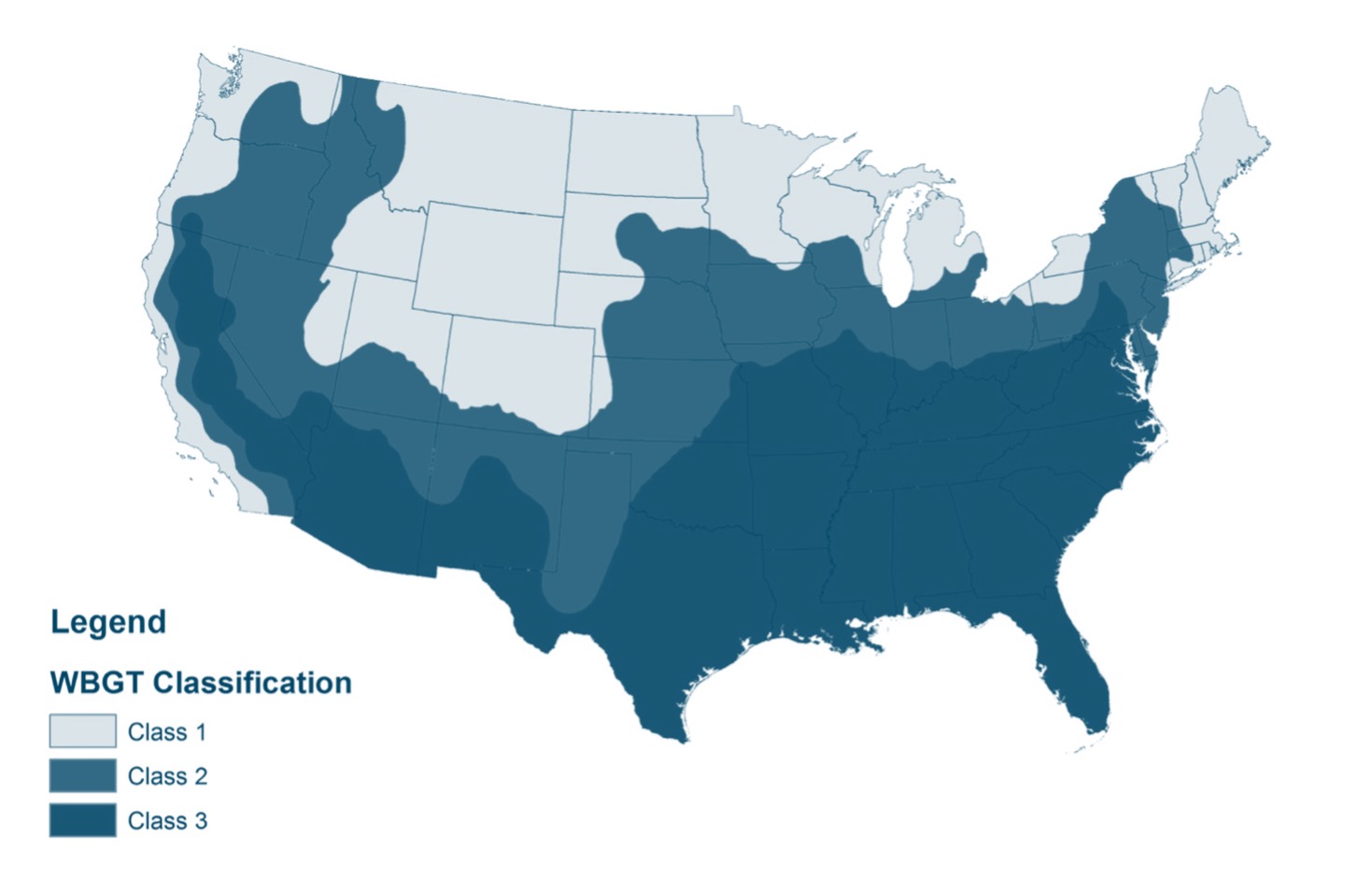
Heathens uses Class 2 as its stricter statewide reference. Schools use their local UIL class. See both sets of bands.
Dallas
––°F WBGT
Loading forecast…
Austin
––°F WBGT
Loading forecast…
San Antonio
––°F WBGT
Loading forecast…
Houston
––°F WBGT
Loading forecast…
Lubbock
––°F WBGT
Loading forecast…
El Paso
––°F WBGT
Loading forecast…
Corpus Christi
––°F WBGT
Loading forecast…
Brownsville
––°F WBGT
Loading forecast…
Amarillo
––°F WBGT
Loading forecast…
Midland
––°F WBGT
Loading forecast…
Texarkana
––°F WBGT
Loading forecast…
Beaumont
––°F WBGT
Loading forecast…
San Angelo
––°F WBGT
Loading forecast…
Wichita Falls
––°F WBGT
Loading forecast…
Click a city for a five-day outlook, hourly WBGT curve, and daytime planning windows. Current-hour forecasts are not worksite measurements; colored flags show the selected UIL comparison class.
The required UIL practice bands
Both classes are shown in °F WBGT. The selected column is highlighted. These are required school-practice protocols; the practice limits do not apply to UIL competitions, although rapid-cooling requirements still apply.
| Flag | Class 2 | Class 3 | School-practice requirement |
|---|---|---|---|
| Green | <79.7 | <82.0 | At least three recovery breaks per hour, each at least 3 minutes. |
| Yellow | 79.7–84.6 | 82.0–86.9 | At least three 4-minute breaks per hour. On-site rapid cooling required. |
| Orange | 84.7–87.6 | 87.0–90.0 | Maximum 2-hour practice; at least four 4-minute breaks per hour. Equipment restrictions for football. Rapid cooling required. |
| Red | 87.7–89.7 | 90.1–92.0 | Maximum 1-hour practice; 20 minutes of recovery breaks in that hour. No football protective equipment or conditioning. Rapid cooling required. |
| Black | ≥89.8 | ≥92.1 | No outdoor workouts. Delay practice until a cooler WBGT is reached. |
Required UIL heat plan · Scope and regional-class FAQs
Which class applies?
UIL schools use Class 2 or Class 3 according to their local region. Near a boundary, UIL allows schools to make a consistent local determination. Heathens retains Class 2 as a stricter statewide comparison default. Selecting Class 3 changes the comparison throughout this preview.
79.7 / 82.0°F
Rapid-cooling readiness
UIL requires an on-site rapid-cooling zone from the start of yellow conditions: 79.7°F in Class 2 and 82.0°F in Class 3. This includes the ability to provide full-body cold-water immersion or an equivalent ice-water tarp response.
For a crew, an emergency response plan and a way to cool someone rapidly belong in the heat plan. Heat illness can occur below these readings.
89.8 / 92.1°F
The outdoor-practice cutoff
UIL stops outdoor workouts at the black band. That gives Texas a concrete policy precedent for restricting exertion in extreme heat.
Our position: employers should postpone strenuous outdoor labor at black-band conditions and arrange cooler work. Protection may be needed much earlier, and a regional estimate cannot approve a jobsite as safe.
Read the estimates honestly
This tracker calculates an outdoor WBGT approximation from NWS forecast temperature, humidity, wind, and time of day. Sun exposure is modeled; cloud cover is inferred from the forecast description. These are not official NWS WBGT readings or instrument measurements.
Actual conditions can be higher or lower. Attics, hot equipment, roof surfaces, blocked airflow, and protective clothing require a worksite assessment. A green UIL comparison does not establish that labor is safe.
OSHA’s occupational heat guidance considers workload, acclimatization, clothing, and on-site conditions. It can call for controls below the school-practice thresholds.
What WBGT tells us
WBGT combines air temperature, humidity, radiant heat, and air movement into an environmental heat-stress index. Working muscles also generate heat. The same environmental reading can therefore mean different risks for a seated worker and a crew carrying equipment.
Heat index is calculated for shaded conditions and does not directly account for workload, wind, or radiant heat. Neither a weather forecast nor the absence of a public heat warning establishes safe working conditions.
The archive: a concentration worth investigating
Of the archive’s 71 cases with saved WBGT estimates, 55 fall between 85°F and 95°F — about 77%. Another 13 exceed 95°F; three fall below 85°F. Four cases have no estimate.
Those saved values use a different, simplified temperature-and-humidity approximation. They are weather context, not measured exposure or a validated danger boundary. The archive includes attribution caveats and indoor or process-heat cases. A collection of fatal cases alone cannot tell us the risk per hour worked at each temperature.
School-practice comparison: UIL 2026–2027 required heat protocols. Live figures: a forecast-based approximation. Use workplace measurements and occupational guidance to assess the job.